

Mining Is a Process, Not a Place
Mining is often perceived as a single location—a pit, a tunnel, or a site of heavy machinery. In reality, mining is a structured, multi-stage process that begins long before extraction and continues well after operations cease. Understanding this lifecycle is essential for evaluating mining from technical, economic, and environmental perspectives.
- Exploration: Finding Potential Beneath the Surface
Exploration is the foundation of all mining activities. It involves geological mapping, geophysical surveys, geochemical sampling, and subsurface analysis to identify areas with mineral potential. At this stage, no extraction occurs. Instead, data and scientific interpretation guide decisions.
Mining begins with knowledge, not machinery. - Discovery: From Potential to Viable Resource
A discovery occurs when exploration data confirms the presence of a mineral deposit with economic value. However, not every discovery becomes a mine. Technical feasibility, market demand, regulatory frameworks, and environmental considerations determine whether development proceeds.
Discovery represents possibility—not certainty. - Extraction: Accessing the Resource
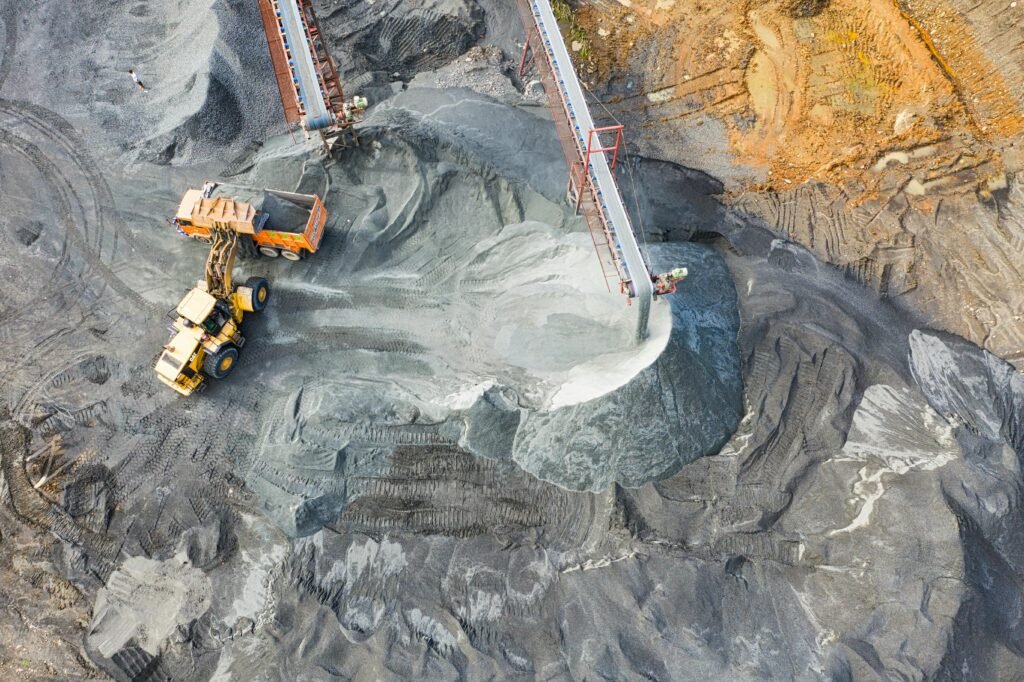
Extraction is the most visible phase of mining. Depending on geological conditions, minerals are removed through open-pit, underground, or other specialized methods. This stage involves significant land modification and requires strict operational and safety controls.
Extraction is where geological resources intersect with human activity. - Processing: Transforming Rock into Material
Once extracted, ore undergoes processing to separate valuable minerals from waste rock. This may include crushing, grinding, concentration, and refining. Processing transforms raw material into inputs usable by industry.
At this stage, rock becomes resource. - Distribution: Connecting Mines to Markets
Processed materials are transported through supply chains to manufacturers and global markets. Metals and minerals support construction, energy systems, electronics, and infrastructure. Although rarely visible to consumers, mining plays a critical role in modern life.
Mining connects the Earth to the global economy. - Restoration: The Responsibility After Mining
Restoration begins as mining operations wind down and continues after closure. Land rehabilitation aims to stabilize terrain, restore ecosystems, and return land to productive use. Effective restoration reflects long-term planning and environmental accountability.
Mining ends, but the land remains.
Conclusion
Viewing mining as a process rather than a place provides a more accurate and responsible understanding of the industry. Each stage—from exploration to restoration—carries technical, economic, and environmental implications. Sustainable mining depends not on a single phase, but on how the entire lifecycle is managed.