

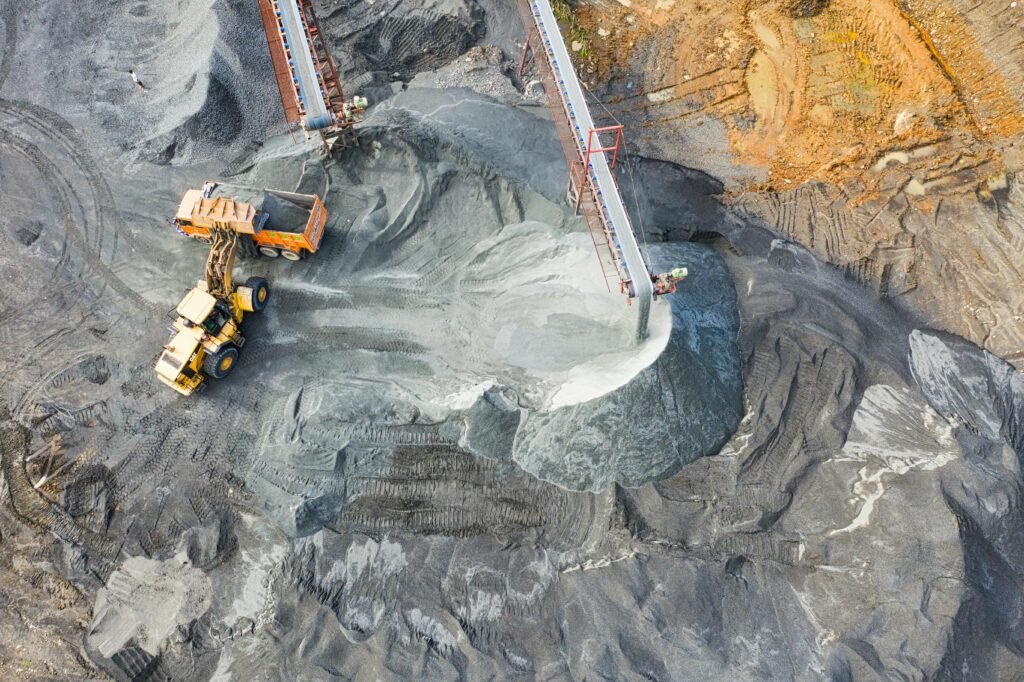
Mining exploration is the most critical and high-risk phase in the mining value chain. Before a single ton of ore is extracted, companies must invest time, expertise, and capital to determine whether a mineral deposit is economically viable. This stage combines geology, engineering, environmental awareness, and data science to reduce uncertainty and guide investment decisions.
- Geological Mapping
Exploration begins with geological mapping. Geologists analyze surface rock formations, structural features such as faults and folds, and regional geological history. By understanding tectonic settings and mineralization patterns, they identify target zones with higher potential for mineral deposits.
Modern exploration integrates traditional field mapping with digital geographic information systems (GIS) to improve spatial accuracy and data management. - Remote Sensing and Geophysical Surveys
Advanced technologies significantly enhance exploration efficiency. Satellite imagery, drone surveys, magnetic mapping, and seismic methods detect subsurface anomalies without disturbing the ground.
These tools help identify variations in rock density, magnetic properties, and structural patterns that may indicate mineralization. Non-invasive methods reduce environmental impact while expanding coverage over large and remote areas. - Geochemical Sampling
Geochemical analysis involves collecting soil, rock, and water samples to detect trace elements associated with mineral deposits. Even small concentrations of indicator minerals can signal the presence of valuable resources beneath the surface.
Laboratory analysis ensures accurate chemical profiling, which supports data-driven targeting for further investigation. - Exploratory Drilling
Drilling is the most decisive stage of exploration. Core drilling retrieves cylindrical rock samples from below the surface, allowing geologists to directly examine mineral composition, grade distribution, and structural continuity.
Drill data determines whether a deposit meets economic thresholds for development. This phase often represents a significant portion of exploration costs. - Resource Estimation and Modeling
All collected data — geological, geophysical, and geochemical — are integrated into three-dimensional models using specialized software. Resource estimation quantifies the volume, grade, and economic potential of the deposit.
At this stage, companies evaluate financial feasibility, risk exposure, and long-term sustainability before moving to the development phase.
Strategic Importance of Exploration
Exploration is not merely about discovering minerals. It is a strategic risk-management process that protects investors, ensures regulatory compliance, and supports responsible resource development.
A well-executed exploration program:
Reduces geological uncertainty
Improves capital allocation decisions
Supports environmental planning
Strengthens project credibility
In today’s mining industry, exploration success depends on interdisciplinary collaboration, technological innovation, and responsible environmental stewardship.