

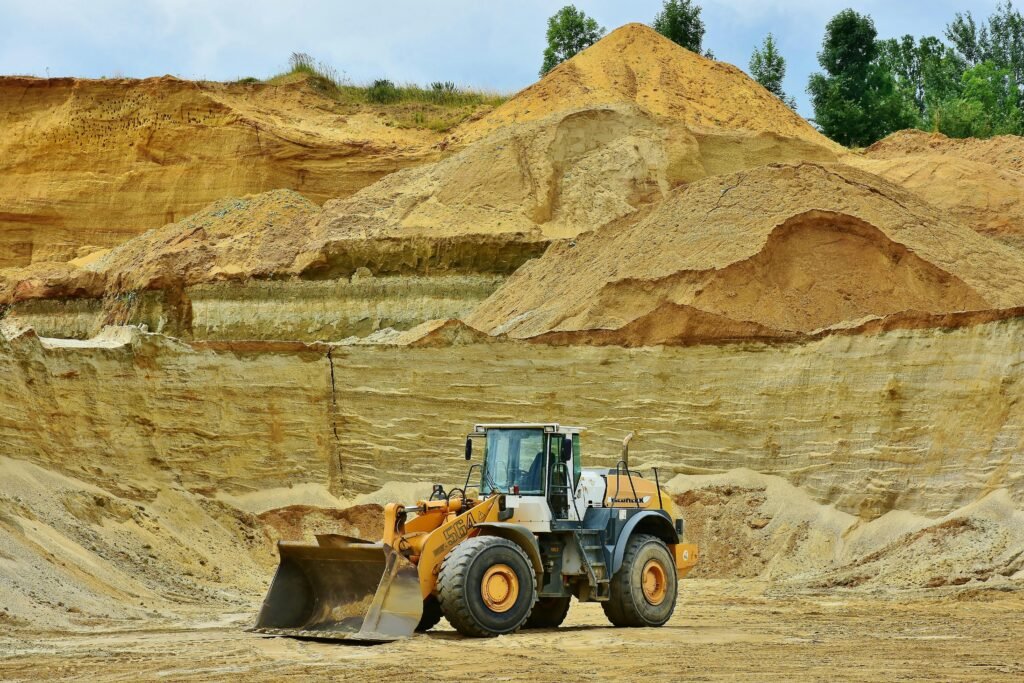
Understanding why mineral deposits form in specific locations requires a look into the geological processes that shape the Earth over millions of years. Mining operations rely heavily on this knowledge, as geology determines not only where minerals occur, but also how they can be extracted efficiently and safely. This article outlines the four fundamental geological processes that influence mineral formation: sedimentation, magmatic activity, metamorphism, and tectonic movement.
- Sedimentary Processes: Minerals Form Through Deposition
Sedimentary processes occur when materials such as sand, silt, or organic matter are transported by water, wind, or ice and gradually accumulate in layers. Over long periods, these deposits compact and lithify into sedimentary rocks.
This environment produces mineral resources such as:
Coal, formed from accumulated plant material.
Silica sand, commonly used in glass and industrial applications.
Limestone, widely used in construction and cement manufacturing.
Sedimentary deposits are typically found in horizontal, layered formations, making them relatively accessible for mining. - Magmatic Processes: Minerals from Cooling and Crystallization
Many of the world’s most valuable minerals originate from molten rock. As magma cools—either slowly beneath the Earth’s surface or rapidly after eruption—it begins to crystallize, allowing minerals to form.
This process is responsible for deposits of:
Nickel
Copper
Gold
Platinum group metals
These minerals often occur near igneous intrusions or within crystallized magma chambers, where mineral-rich fluids concentrate specific elements. - Metamorphic Processes: Transformation Under Pressure and Heat
Metamorphic processes take place when existing rocks are subjected to intense heat, pressure, or chemically active fluids, causing them to undergo physical or chemical transformation.
Common metamorphic minerals include:
Graphite
Talc
Garnet
These deposits frequently occur in regions with a history of tectonic collision or deformation, making them important indicators of past geological activity. - Tectonic Activity: Creating Pathways for Mineral-Rich Fluids
The movement of tectonic plates continuously reshapes the Earth’s structure. As plates shift, they create fractures, faults, and conduits within the crust. These openings become pathways for hydrothermal fluids—hot water infused with dissolved minerals.
When these fluids cool and solidify, they form mineral veins, such as:
Quartz-gold veins
Hydrothermal copper deposits
Tectonic zones are therefore highly prospective regions for mineral exploration due to their dynamic geological environment.
Conclusion: Mineral Deposits Are the Result of Long Geological Histories
The presence of mineral resources is never random. Every deposit reflects a combination of geological processes that occurred over millions of years:
Sedimentation
Magmatic crystallization
Metamorphism
Tectonic movement
Modern mining depends on understanding these processes to locate, evaluate, and extract minerals responsibly. By interpreting the Earth’s geological history, mining companies can identify economically viable resources while planning sustainable operations for the future.