

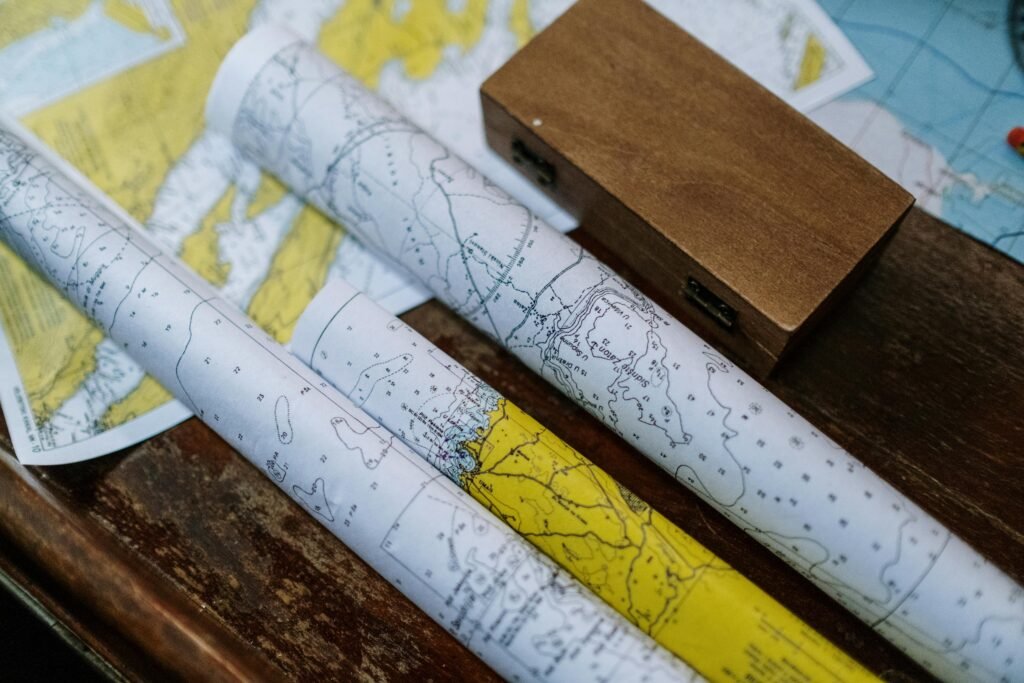
At first glance, a place may appear fixed and unchanging. Mountains stand where they stand, rivers follow their course, and cities grow upon familiar ground. Yet in mapping, a single location can be represented in many different ways—each revealing a distinct story. This is the core idea behind “One Place, Many Maps.”
Mapping is not simply about location. It is about purpose.
Mapping Depends on What We Want to Know
Every map is created to answer a specific question. A hiker, an urban planner, a geologist, and a disaster manager may all focus on the same region, but each requires different information. As a result, they produce different maps—none of which are wrong, but none of which tell the whole story on their own.
Topographic Maps: Understanding the Physical Surface
Topographic maps represent elevation, slopes, and landforms through contour lines. They are essential for navigation, engineering, and terrain analysis. These maps help us understand how steep a landscape is, where water may flow, and how accessible an area might be.
Land Use Maps: How Humans Occupy Space
Land use maps focus on how people utilize land—such as residential areas, agriculture, forests, or industrial zones. They are fundamental for spatial planning, environmental management, and policy decisions. While topographic maps show the natural surface, land use maps reveal human influence.
Geological Maps: What Lies Beneath
Geological maps depict rock types, structures, and fault lines below the surface. These maps are critical in mining, construction, and hazard assessment. Two places that look identical on the surface may be vastly different geologically, and only geological mapping reveals this hidden complexity.
Infrastructure Maps: Connecting Space
Infrastructure maps highlight roads, railways, utilities, and public facilities. They show how space is connected and how people, goods, and services move through a region. These maps are central to urban development, transportation planning, and public service delivery.
Hazard and Risk Maps: Mapping Potential Threats
Hazard maps identify areas prone to floods, earthquakes, landslides, or tsunamis. Rather than describing what exists today, these maps anticipate what could happen. They play a crucial role in disaster preparedness, risk reduction, and saving lives.
Why Multiple Maps Matter
No single map can fully represent reality. Each map simplifies the world by emphasizing certain elements and ignoring others. Understanding a place requires viewing it through multiple mapping lenses. When these perspectives are combined, decision-making becomes more informed, responsible, and sustainable.
Conclusion
One place can never be captured by a single map. Instead, it exists as a collection of representations—each shaped by data, purpose, and perspective. Recognizing this helps us read maps more critically and use them more wisely.
In mapping, diversity of perspective is not a limitation.
It is a strength.