

Mining operations are often perceived as a display of massive machines moving earth at scale. In reality, modern mining is not defined by machine size alone, but by system integration. Every ton of material extracted is the result of a coordinated sequence involving excavation, hauling, ground preparation, drilling, fragmentation, and processing.
Understanding mining equipment means understanding how each unit fits into a larger operational chain.
- Excavation: The Starting Point of Material Movement
At the core of material extraction is the Excavator.
In surface mining, excavators are responsible for:
Removing overburden
Extracting ore
Loading material into haul trucks
Productivity at this stage directly influences downstream efficiency. Bucket capacity, cycle time, swing angle optimization, and operator precision all determine output rates. Even minor inefficiencies in digging can propagate into delays across the entire production chain.
Modern mining operations increasingly integrate GPS guidance and fleet management systems to optimize digging accuracy and reduce rehandling. - Hauling: The Cost-Driver of Mining Operations
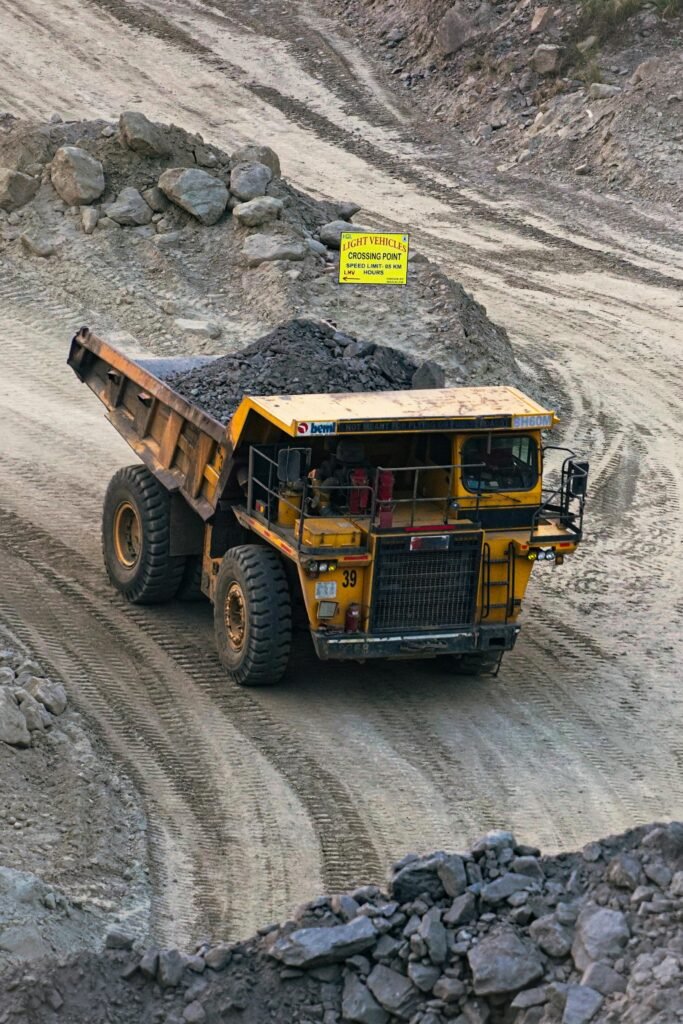
After excavation, material must be transported. This is where the Dump Truck becomes critical.
Hauling is often the largest operating cost component in open-pit mining due to:
Fuel consumption
Tire wear
Maintenance cycles
Road condition impacts
Key performance indicators include:
Payload optimization
Haul cycle time
Availability and utilization rates
Strategic road design, proper gradient control, and dispatch system integration significantly reduce cost per ton. In high-volume operations, even a 5% improvement in haul efficiency can translate into substantial annual savings. - Ground Control & Site Preparation
Before and during extraction, terrain stability and accessibility must be maintained. The Bulldozer plays a central supporting role.
Primary functions include:
Clearing vegetation and topsoil
Constructing and maintaining haul roads
Managing stockpiles
Stabilizing working platforms
Proper ground preparation enhances safety, reduces equipment strain, and extends tire and undercarriage lifespan. Without consistent dozer support, operational risks increase significantly. - Drilling & Fragmentation Engineering
In hard rock mining, excavation cannot proceed without fragmentation. The Drilling Rig is used to create blast holes according to engineered drilling patterns.
Drilling precision determines:
Fragmentation quality
Explosive efficiency
Downstream crushing performance
Poor fragmentation results in oversized material, which:
Increases crusher energy demand
Slows loading cycles
Accelerates equipment wear
Blasting design is therefore not merely an upstream task — it directly affects plant throughput and operational cost structure. - Crushing & Size Reduction
Once material reaches the processing stage, mechanical reduction begins using a Crusher.
Crushing systems determine:
Throughput rate
Product size distribution
Energy intensity per ton
Primary, secondary, and tertiary crushing stages may be employed depending on ore characteristics and production targets. Equipment selection at this phase influences both capital expenditure (CAPEX) and long-term operational expenditure (OPEX).
Efficient crushing reduces bottlenecks and ensures stable feed to downstream processing plants.
Mining Equipment as an Integrated Ecosystem
What distinguishes high-performing mining operations is not the presence of advanced machinery alone, but how effectively each unit is synchronized.
Key integration elements include:
Fleet management systems
Predictive maintenance analytics
Real-time production monitoring
Operator training and safety protocols
Mining equipment does not operate independently. It functions as a structured ecosystem where excavation efficiency influences hauling demand, drilling accuracy impacts crushing performance, and ground management supports operational continuity.
Operational Risk and Equipment Strategy
Heavy equipment decisions carry financial implications:
Under-capacity equipment → production bottlenecks
Over-capacity equipment → idle cost & capital inefficiency
Poor maintenance planning → unplanned downtime
Inefficient dispatch → fuel waste & productivity loss
Strategic fleet composition requires alignment with:
Mine design
Ore body characteristics
Production targets
Life-of-mine planning
Equipment strategy is therefore a long-term financial decision, not merely a procurement activity.
Conclusion
Heavy mining equipment represents more than mechanical force. It embodies a carefully engineered production system where timing, precision, and integration determine operational success.
From the excavator initiating material flow to the crusher finalizing size reduction, each machine contributes to a coordinated chain of value creation.
In modern mining, productivity is not about moving more earth — it is about moving earth more intelligently.