

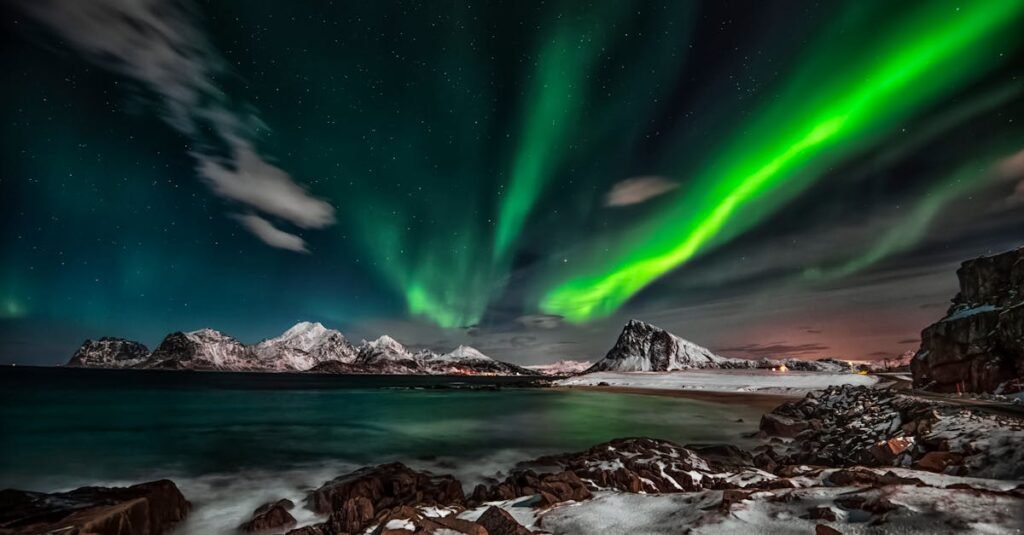
Auroras have long fascinated travelers, photographers, and scientists alike. These shimmering curtains of green, red, and violet light—known as the Northern Lights (Aurora Borealis) and Southern Lights (Aurora Australis)—paint the polar skies with an almost otherworldly glow. But behind their beauty lies a remarkable interaction between the Sun and Earth’s atmosphere. Here’s a clear and professional breakdown of how auroras actually form.
- It All Begins With the Sun
The Sun is constantly releasing streams of charged particles, including electrons and protons, into space. This flow is known as the solar wind. Although Earth is 150 million kilometers away, these particles travel at incredible speeds and regularly reach the planet’s outer atmosphere.
During periods of high solar activity—such as solar flares or coronal mass ejections—the intensity of the solar wind increases. These events often lead to particularly bright and widespread aurora displays.
- Earth’s Magnetic Field Takes Control
When the solar wind approaches Earth, it doesn’t strike the planet evenly. Instead, it encounters Earth’s magnetic field, a protective shield that surrounds the planet and extends far into space. The magnetic field deflects most of the particles, but some become trapped and guided along magnetic field lines.
These field lines naturally converge at the North and South Poles, which is why auroras are most commonly observed in high-latitude regions such as Norway, Alaska, Canada, Iceland, and Antarctica.
- Collisions in the Upper Atmosphere
As the charged particles spiral toward the poles, they eventually penetrate Earth’s upper atmosphere—specifically the thermosphere, located roughly 80–500 km above the surface.
Here, the particles collide with atoms and molecules of oxygen and nitrogen. These collisions excite the atmospheric gases, causing them to absorb energy. When the gases return to their normal state, they release that energy as light. This process is similar to how neon signs glow.
The result? Waves, arcs, and ribbons of luminous color moving across the sky.
- Why Auroras Have Different Colors
The colors of an aurora depend on two factors:
(1) the type of gas being excited, and
(2) the altitude of the collision.
Green — The most common color, produced by oxygen molecules at around 100–250 km altitude.
Red — Produced by high-altitude oxygen (above 250 km).
Blue and Purple — Caused by nitrogen molecules at lower altitudes.
Pink — A mixture of emissions from both nitrogen and oxygen.
These variations in color create the stunning palettes often captured in aurora photography.
- Why Auroras Occur Mainly in Polar Regions
Auroras appear near the poles because of how Earth’s magnetic field lines are shaped. The field lines curve inward at the polar regions, channeling solar particles into a narrow zone around the magnetic poles. This region is known as the auroral oval.
During strong geomagnetic storms, however, the auroral oval can expand, allowing auroras to be seen much farther from the poles—even as far south as the United States or mainland Europe.
- A Natural Light Show Written by Space Weather
In essence, auroras are the visible result of a complex yet elegant chain reaction: solar energy traveling across space, Earth’s magnetic field redirecting it, and atmospheric gases releasing colorful light upon impact. What we see as dancing lights in the sky is actually a real-time display of space weather at work.
Auroras remind us of how dynamic our planet is—and how deeply connected Earth is to the Sun’s energy. Whether witnessed from the Arctic Circle or through satellite imagery, they remain one of the most stunning natural spectacles on Earth.