

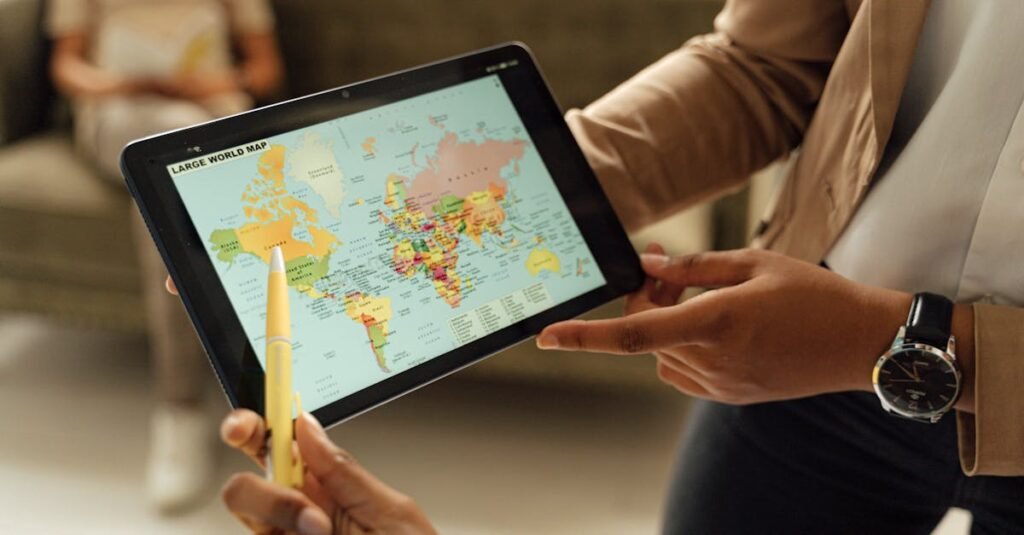
Maps have long been fundamental tools for representing the Earth’s surface, enabling humans to understand spatial relationships, navigate environments, and analyze geographic data. In today’s increasingly data-driven world, maps have evolved beyond static representations into dynamic and interactive systems. Each type of map serves a distinct purpose, depending on the information it aims to convey.
- Physical Maps: Visualizing Natural Landscapes
Physical maps are designed to illustrate the Earth’s natural features. These include mountains, rivers, valleys, and oceans. Typically, variations in color and shading are used to represent differences in elevation and terrain.
Such maps are essential in environmental studies, geology, and education, as they provide a clear understanding of the Earth’s physical structure. They are particularly useful for identifying landforms and analyzing natural processes. - Political Maps: Defining Human-Made Boundaries
Political maps focus on administrative and territorial divisions created by humans. These include countries, provinces, cities, and borders. Unlike physical maps, political maps emphasize governance rather than natural features.
They play a crucial role in education, international relations, and policy-making by helping users understand geopolitical structures and jurisdictional boundaries. - Topographic Maps: Representing Elevation and Terrain
Topographic maps provide detailed information about the shape and elevation of the land. They use contour lines to represent areas of equal elevation, allowing users to interpret slopes, peaks, and valleys.
These maps are widely used in engineering, land-use planning, military operations, and outdoor activities such as hiking. Their precision makes them invaluable for understanding terrain in three dimensions. - Thematic Maps: Focusing on Specific Data
Thematic maps are specialized maps that display particular types of data, such as population density, climate patterns, or natural resource distribution. Instead of general geographic features, they highlight specific themes or datasets.
These maps are widely used in research, urban planning, and decision-making processes, as they allow for the visualization of complex data in an accessible format. - Digital Maps: Enabling Real-Time Navigation
With advancements in technology, digital maps have transformed how people interact with geographic information. These maps are interactive and often integrated with Global Positioning System (GPS) technology, providing real-time navigation and updates.
Digital maps are now indispensable in everyday life, supporting activities such as travel, logistics, and location-based services. Their ability to deliver accurate, real-time information has significantly improved efficiency and accessibility.
Conclusion
Maps are more than mere representations of space—they are powerful tools for communication, analysis, and decision-making. From traditional physical and political maps to advanced digital systems, each type contributes uniquely to our understanding of the world.
As technology continues to evolve, the role of maps will become even more significant, bridging the gap between geographic data and practical application in various fields.