

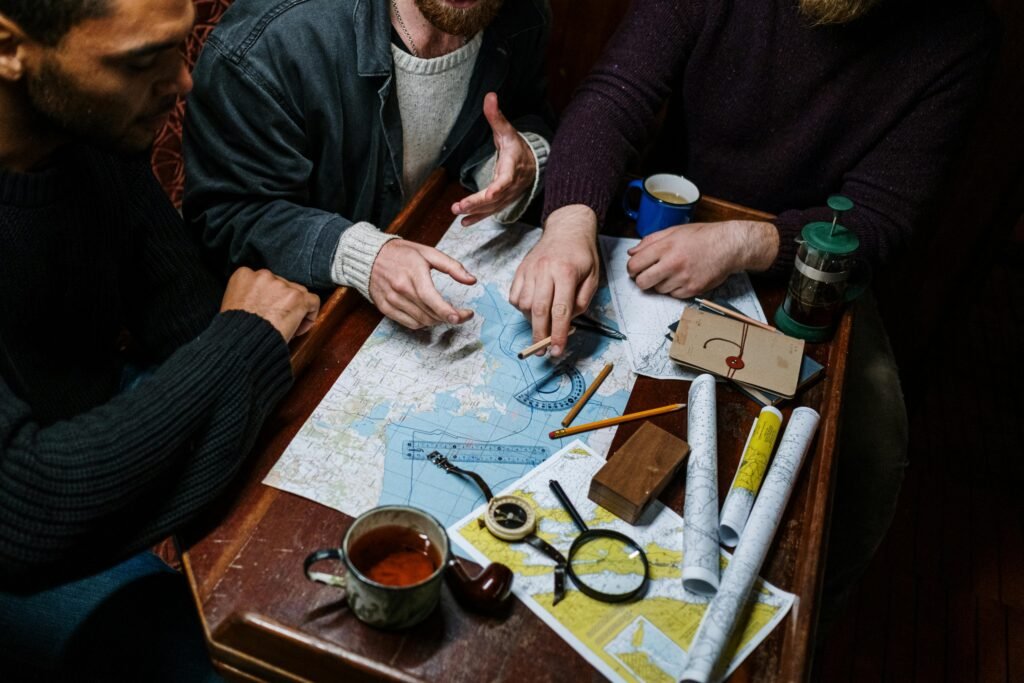
Maps are often perceived as simple navigation tools. In reality, certain types of maps—particularly topographic maps—serve as scientific models that translate the Earth’s three-dimensional surface into structured, measurable information. Three key concepts make this possible: elevation, contour lines, and relief.
Understanding these elements allows us to read landscapes scientifically rather than visually.
Elevation: Measuring Height Above Sea Level
Elevation refers to the vertical height of a specific point on the Earth’s surface relative to mean sea level. It explains why coastal plains, plateaus, hills, and mountains differ in physical form and environmental characteristics.
In mapping, elevation is not merely descriptive. It is a quantitative variable used in hydrology, climate analysis, urban planning, and hazard assessment. Changes in elevation influence temperature, water flow, soil development, and vegetation patterns.
Contour Lines: Translating Height into Lines
Contour lines are one of the most important tools in topographic mapping. Each line connects points of equal elevation, allowing a flat map to communicate vertical variation.
The spacing of contour lines conveys slope:
Closely spaced lines indicate steep terrain
Widely spaced lines indicate gentle slopes
By reading contour patterns, cartographers and map users can identify ridges, valleys, peaks, and depressions without ever seeing the terrain in person.
Relief: Understanding Terrain Variation
Relief refers to the difference between the highest and lowest elevations within a specific area. It provides a measure of how rugged or flat a landscape is.
Areas with high relief—such as mountain ranges—tend to have greater geological complexity and higher risks of landslides or erosion. Areas with low relief, such as floodplains, are often more suitable for agriculture and urban development but may be vulnerable to flooding.
Relief helps transform elevation data into meaningful spatial interpretation.
Why Topographic Information Matters
Elevation, contours, and relief are not abstract concepts. They are essential for real-world decision-making, including:
Flood and landslide risk assessment
Infrastructure and transportation planning
Natural resource management
Navigation, hiking, and rescue operations
Without topographic information, maps would lack critical environmental context.
Maps as Scientific Models
Topographic maps are not photographs. They are scientific abstractions designed to simplify complex terrain while preserving spatial accuracy. By converting three-dimensional landscapes into two-dimensional representations, maps allow humans to analyze, predict, and plan within physical environments.
In this sense, maps do not merely show the Earth—they interpret it through data.
Conclusion
Contours, elevation, and relief form the foundation of scientific mapping. Together, they enable maps to function as analytical tools rather than visual illustrations. Understanding these concepts transforms map reading from a basic skill into a form of spatial literacy.