

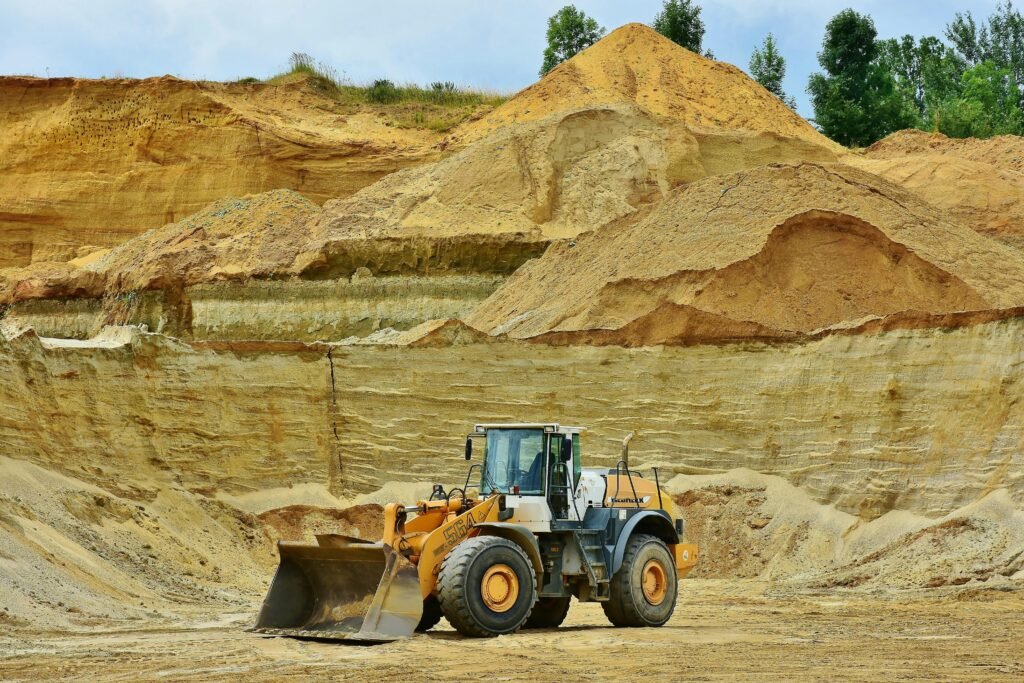
If you’re new to mining, a few terms show up everywhere in reports, presentations, and feasibility studies. Understanding them early helps you read mining information correctly and avoid common misunderstandings. This article breaks down four essentials: stripping ratio, overburden, grade, and the difference between resources and reserves.
1) Stripping Ratio (SR)
Stripping Ratio (SR) describes how much waste material must be removed to extract a unit of ore (or coal). It is most commonly used in surface (open-pit) mining.
Simple formula:
SR = Overburden (or waste) ÷ Ore (or coal)
Example:
An SR of 5:1 means the operation must move 5 tonnes of waste to access 1 tonne of ore/coal.
Why it matters
Stripping ratio is closely tied to cost. In general:
Higher SR → more material moved → higher mining cost
Lower SR → less material moved → usually more economical
That’s why SR is often used as a quick indicator when comparing different pits, pushbacks, or mining phases.
2) Overburden (OB)
Overburden (OB) is the soil and rock that sits above a mineral deposit (ore) or coal seam and must be removed before mining the valuable material.
In simple terms: overburden is the “cover”, while ore/coal is the “target.”
Overburden removal is a major part of mining activity in many surface mines, and it directly influences the stripping ratio.
3) Grade
Grade refers to the concentration of a valuable mineral or metal contained in the rock.
Common grade units include:
Percent (%) for many base metals (e.g., nickel, copper)
Grams per tonne (g/t) for precious metals (e.g., gold)
Examples:
Nickel ore at 1.6% Ni
Gold ore at 1.2 g/t Au
What grade tells you (and what it doesn’t)
A higher grade often indicates more value per tonne of rock. However, grade alone does not guarantee profitability—processing cost, recovery, impurities, and logistics also matter.
4) Resources vs Reserves
These two terms are frequently confused, but they are not interchangeable.
Resources
Mineral Resources are concentrations of minerals with reasonable prospects for eventual economic extraction, based on geological evidence and sampling. In practice, resources represent what is believed to exist with varying levels of confidence (e.g., inferred, indicated, measured).
Reserves
Mineral Reserves are the portion of resources that can be mined economically under defined conditions—after technical and economic studies (and usually after mine planning, metallurgical considerations, and modifying factors like costs, prices, dilution, and recovery).
A useful memory aid:
Resources = “it’s there” (geology-based)
Reserves = “we can mine it profitably” (study-based)
Because reserves are filtered by feasibility, reserves are typically smaller than resources.
Quick Cheat Sheet
Overburden (OB): the material covering the deposit
Stripping Ratio (SR): waste moved per unit of ore/coal
Grade: concentration of valuable mineral in the rock
Resources vs Reserves: estimated existence vs economically mineable portion