

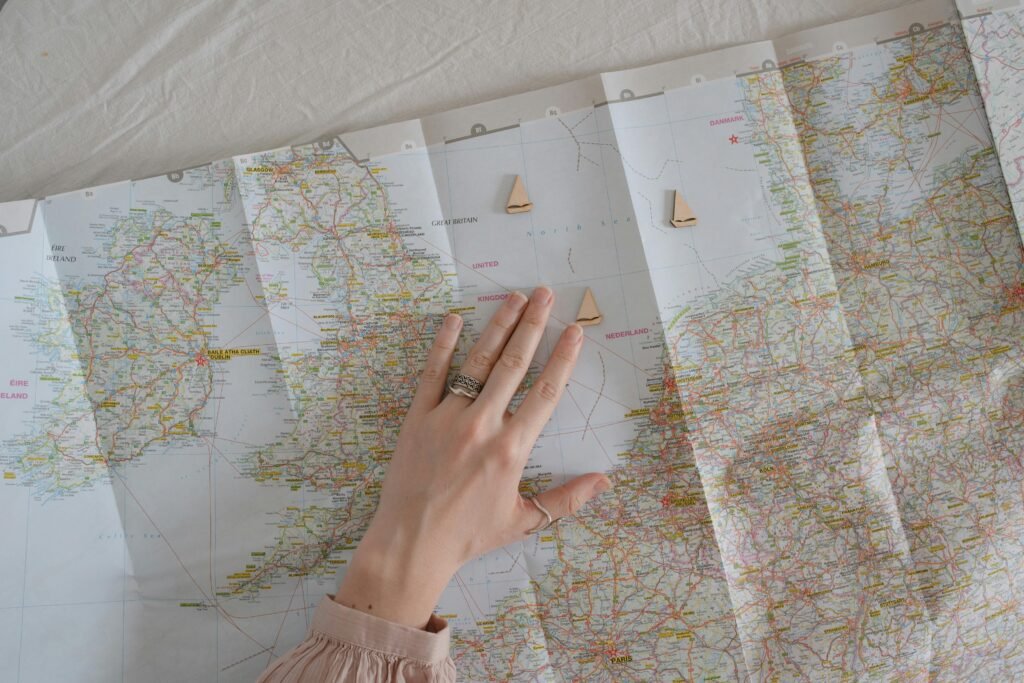
Map scale is a fundamental principle in cartography that defines the relationship between distance on a map and the corresponding distance on the Earth’s surface. Without scale, maps would lack measurable meaning and practical value.
Definition of Map Scale
Map scale is expressed as a ratio that compares map distance to real-world distance. For example, a scale of 1:100,000 indicates that one unit on the map represents 100,000 of the same units on the ground. This proportional reduction allows large geographic areas to be represented accurately on a smaller surface.
Types of Map Scale
There are three primary formats used in mapping practice. Numerical scale is written as a ratio (e.g., 1:50,000). Graphic scale appears as a bar divided into measurable segments. Verbal scale describes the relationship in words, such as “1 inch equals 1 mile.” Each format serves specific technical and practical purposes.
Large-Scale and Small-Scale Maps
In cartographic terminology, large-scale maps display smaller areas with greater detail, while small-scale maps represent larger areas with less detail. A map with a scale of 1:5,000 provides significantly more precision than a map at 1:1,000,000.
Importance in Professional Applications
Accurate interpretation of map scale is essential in surveying, urban planning, environmental studies, infrastructure development, and mining operations. Selecting the appropriate scale ensures measurement accuracy and supports reliable spatial analysis.
Conclusion
Map scale is not merely a numerical expression; it is the foundation of spatial precision. Understanding and selecting the correct scale directly influences the quality, clarity, and reliability of geographic interpretation.